Structural Drying in Tracy, CA
Structural drying means drying the framing, subfloor, slab and wall cavities, not just the surfaces you can see. The drying team sets equipment to the load of each room and keeps it running until the readings say dry.
(888) 774-9605Get the Tracy drying started today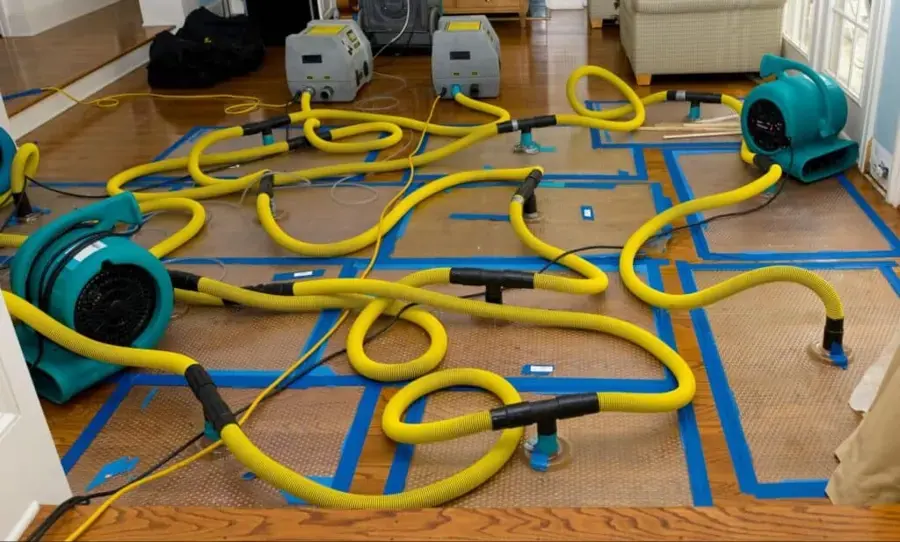
First steps for structural drying in Tracy
- 1
Leave air movers and dehumidifiers running day and night.
- 2
Keep doors and windows in the drying area closed unless the tech says otherwise.
- 3
Keep the thermostat steady and avoid blocking air movers.
- 4
Do not move meters, markers or plastic set by the drying team.
How structural drying is handled in Tracy
- Step 1
Map the moisture
The tech who does the walkthrough maps moisture with thermal imaging and pinless meters before any equipment goes down.
- Step 2
Extract the water
The extraction crew pulls standing water with truck-mounted extraction so it leaves the building instead of moving to the next room.
- Step 3
Set the drying
The drying team sets air movers to each room's evaporation load and runs LGR dehumidifiers to pull that moisture back out of the air.
- Step 4
Verify and document
Readings are logged daily until wet materials sit within 2 to 4 points of a dry reference, and the claim file gets the logs and photos.
What does structural drying cost in Tracy, CA?
In Tracy, CA, structural drying typically runs $300 to $5,000 or more, depending on the class of the loss, the square footage, how much equipment is needed and how many days the drying takes.
Class 1, one room
$300 to $1,200- 2 to 4 air movers
- One dehumidifier
- Daily readings
Class 2 or 3, several rooms
$1,200 to $3,000- Air movers per room load
- LGR dehumidifiers
- Cavity drying
Class 4, dense materials
$3,000 to $5,000+- Floor-drying mats
- Desiccant units
- Extended monitoring
For a closer planning number, try the water damage cost calculator. A firm price comes from the restoration company after it sees the damage.
IICRC S500 is the industry drying standard. It treats drying as a measured process: map the moisture, set the equipment to the conditions, and check the materials every day until they are within 2 to 4 points of a dry reference material in an unaffected part of the same building. The equipment comes out when the readings say dry, not when the surface looks dry.
Class 1 through 4
The class of a loss describes how much water there is to evaporate, and it sets how much equipment a room needs.
- Class 1: part of a room, low-porosity materials, little absorbed water
- Class 2: a whole room, with carpet and pad and water up the walls
- Class 3: water from overhead, soaking ceilings, walls, insulation and floors
- Class 4: dense materials such as hardwood, plaster and concrete that hold water deep inside
The equipment and why it works
Air movers push dry air across wet surfaces so water evaporates faster. LGR (low grain refrigerant) dehumidifiers pull that moisture back out of the air. Desiccant dehumidifiers work better for Class 4 materials and cooler spaces. Floor-drying mats pull air through hardwood, and injection drying sends air inside wall cavities. The drying team sizes each piece to the room's evaporation load instead of guessing.
Tracy's dry summer air helps drying, but winter rain and cool garages slow it. Psychrometric readings, meaning temperature and humidity inside and outside the drying area, show whether the setup is working.
Daily readings and the drying log
Every day, the tech checks the same marked spots with meters and records them with the temperature and humidity. That log shows the drying curve and becomes part of the claim file. The EPA moisture page explains why materials should dry fast, and the Penn State Extension publishes research on wood moisture content in buildings.
Structural Drying coverage across Tracy
The restoration team handles structural drying in every Tracy ZIP and the neighboring San Joaquin County communities.
The restoration team covers all of Tracy, from the downtown grid and Ellis to Tracy Hills, plus Mountain House, Banta, Vernalis, Lathrop and Manteca.
ZIP codes 95304, 95376, 95377, 95378 and 95391.
See every area coveredRelated water damage services in Tracy
Structural Drying questions
What is the IICRC S500?
IICRC S500 is the industry standard for professional water damage restoration. It sets how losses are classified, how drying is done and how the drying goal is verified.
How do I know when my house is actually dry?
The drying team compares daily readings on wet materials with a dry reference in an unaffected part of the same building. The house is dry when the wet materials are within 2 to 4 points of that reference.
Why so many fans?
Air movers are set by the square footage and the wet materials in each room. Too few and the materials stay wet; the number comes from the evaporation load, not guesswork.
Can hardwood floors be saved?
Often, when drying starts quickly. Floor-drying mats pull air through the boards. Hardwood is a Class 4 material, so it dries slower than drywall.
How long does structural drying take?
A contained Class 1 loss usually dries in three to five days. Class 3 and 4 losses with hardwood, plaster or concrete take longer, and the readings decide.
Can I turn the equipment off at night?
It is best to leave it running. Turning it off lets humidity climb and slows drying, which can add days.
Walls, floors or a slab still wet in Tracy?
Surface dry is not structurally dry. The drying team measures, sets the equipment to each room and keeps it running until the readings say dry.